
Point of sale
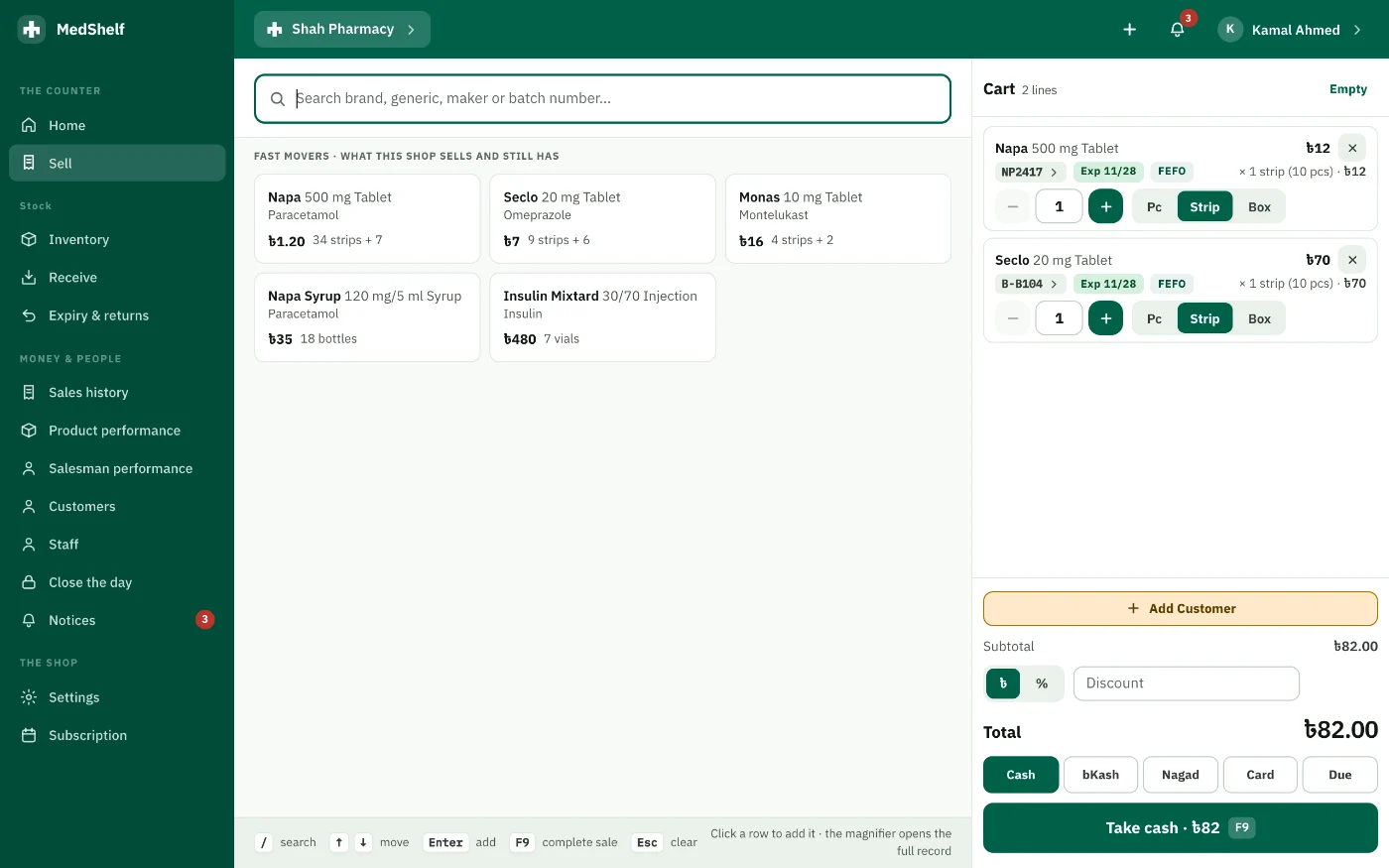
Cash, bKash, Nagad, card or credit, with the amount printed on the button that takes it. Change is counted out before the money moves.
Built for retail pharmacies in Bangladesh
MedShelf is pharmacy management software for Bangladesh — a point of sale, a stock book, a credit book and a day-close in one place. On the Android phone already at your counter, or in any web browser.
Free to try. No setup visits or paperwork required — start selling this afternoon.
Available on Google Play for your counter Android phone.See how a sale works
None of these is a software problem. They are what a busy counter costs a pharmacy when the only record is a register and somebody's memory.
Billing by hand with three customers waiting
Five taps a sale, and the price comes off the exact lot you are handing over.
Nobody is quite sure what is on the shelf
Every sale takes its pieces off as it is rung up, so the shelf figure is the counter's own arithmetic.
Good stock quietly dies on the shelf
MedShelf names the carton, the money still in it, and the day the distributor stops taking it back.
Credit is written in a notebook
Dues sit against the customer and against the invoice, so collecting ৳500 clears the oldest bills first.
The day's profit is a guess
The trade price is captured at the moment of sale, so a delivery landing tomorrow cannot rewrite what today made.
No way to tell who sold what
Every sale carries the person who rang it up — with discount, credit and cancelling each on its own switch.
Tuesday, before opening the pharmacy
sample shopNapa 500mg Tablet — 38 strips on the shelf; distributor returns close on 21 October.
NP2417 · exp 01/27 · Beximco
Seclo 20mg Capsule — auto-blocked from sales, but still physically on the shelf where it could be picked by mistake.
SQ8810 · exp 09/26 · Square
Rahim Mia has not visited since 9 September, with four unpaid invoices still outstanding.
Last night's cash count totaled ৳18,455 — matching the server perfectly.
Five screens from a running MedShelf pharmacy — not mockups. Tap through them the way a shop does in a day: sell at the counter, check the shelf, catch what is expiring, chase a due, read the month.
Search on the left, cart on the right — both on screen at once, which is the whole reason to sell from a browser. Each line shows the carton it draws from, its batch number and expiry, and the total sits on the button that takes the money. The keyboard row along the bottom is how a busy counter stops reaching for the mouse.
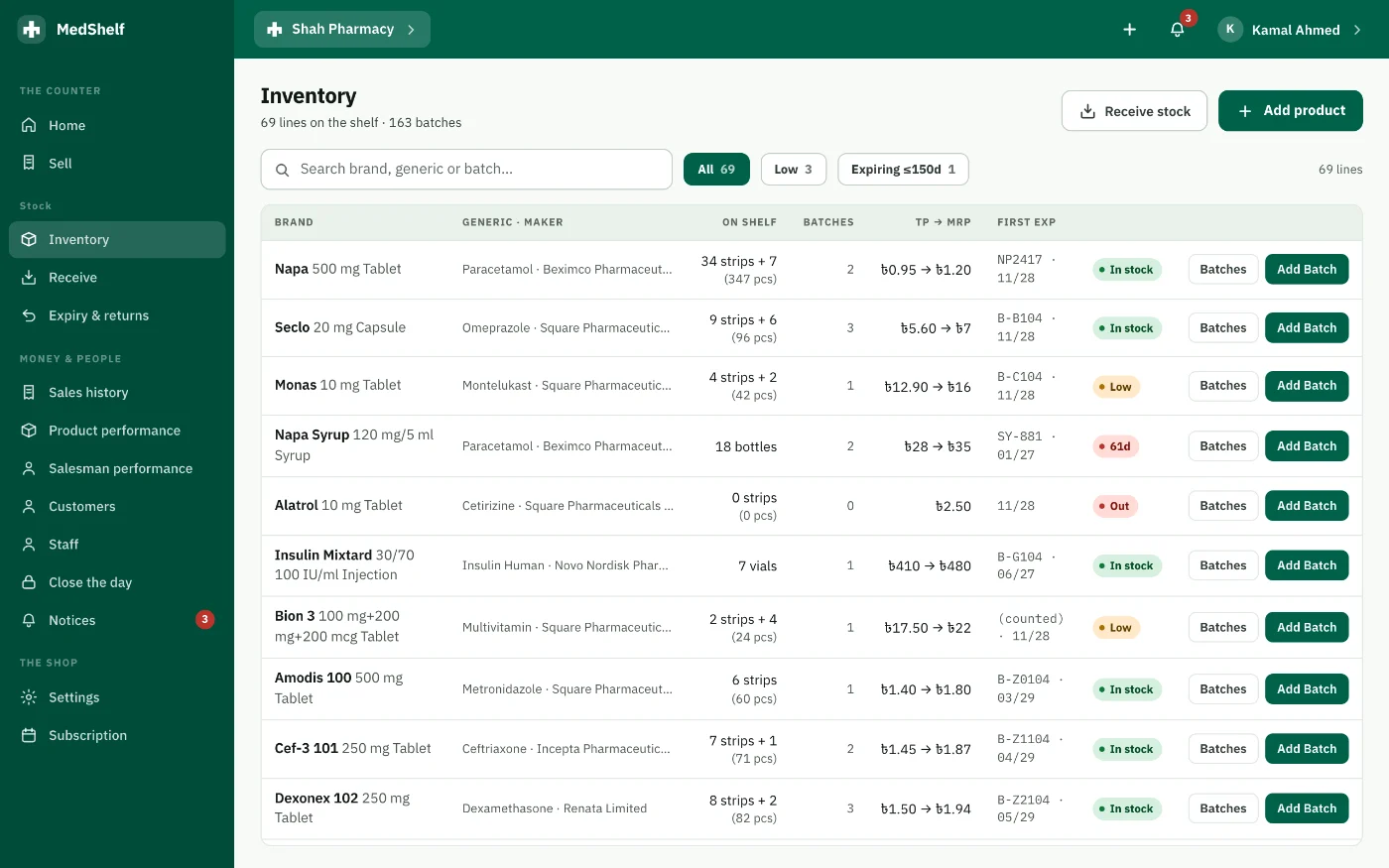
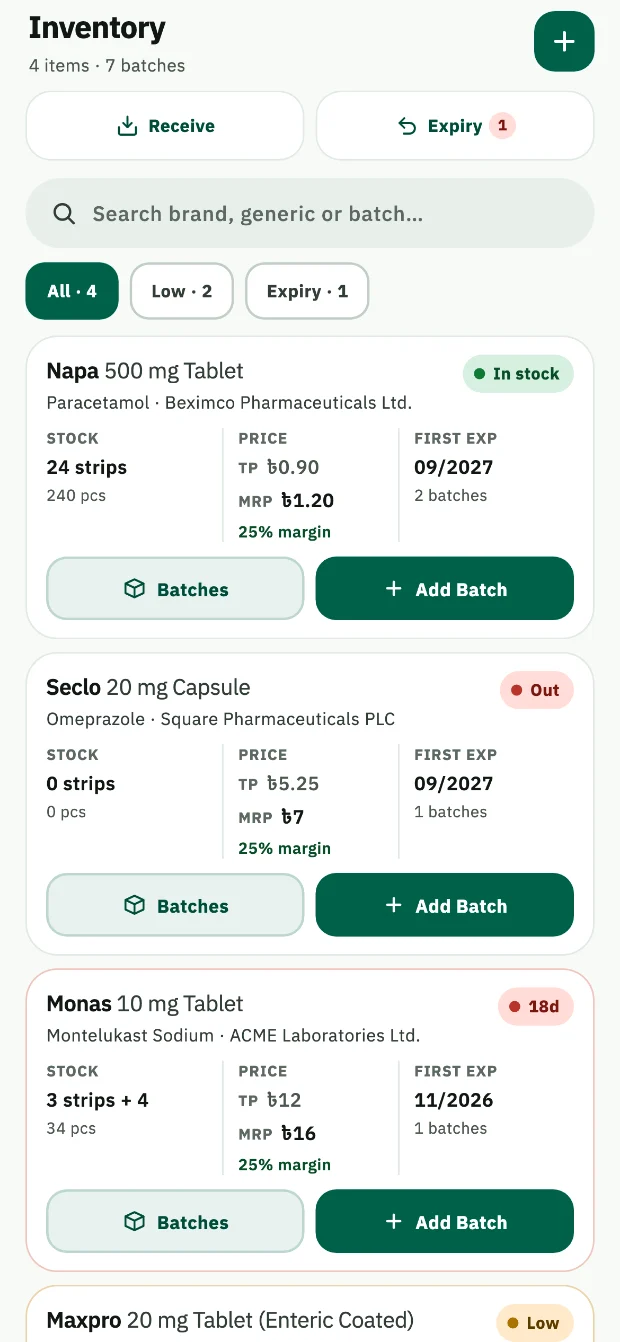
Every brand with what is physically on it, the trade price beside the printed MRP, and one word for the thing to do about it. Search matches a batch number as readily as a brand, and the chips narrow the list to what is low or expiring.
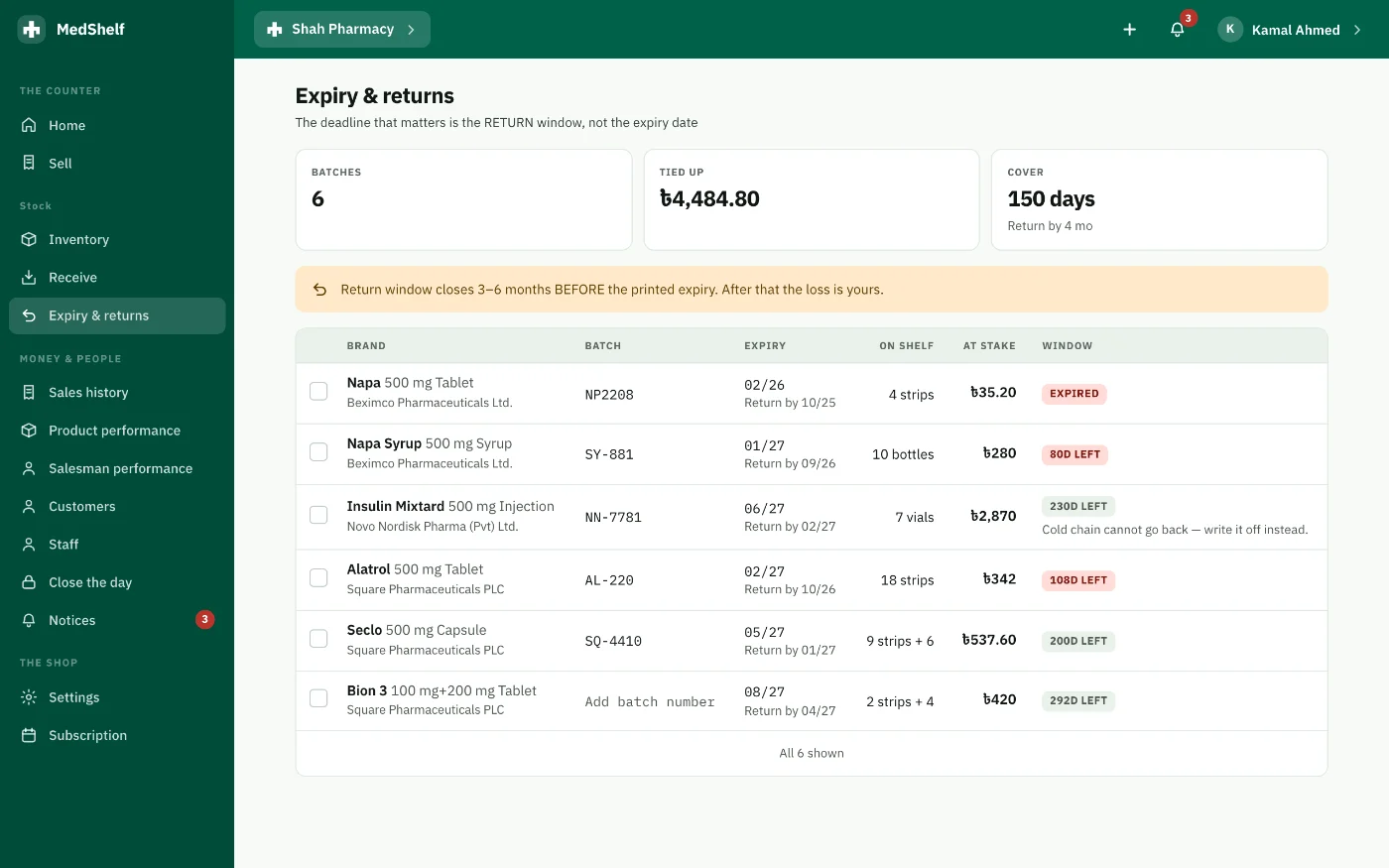
The return deadline is not the expiry date — a distributor stops taking stock back three to six months before it, so the loss lands on product that is still perfectly saleable. This list is ordered by the money still recoverable, carton by carton.
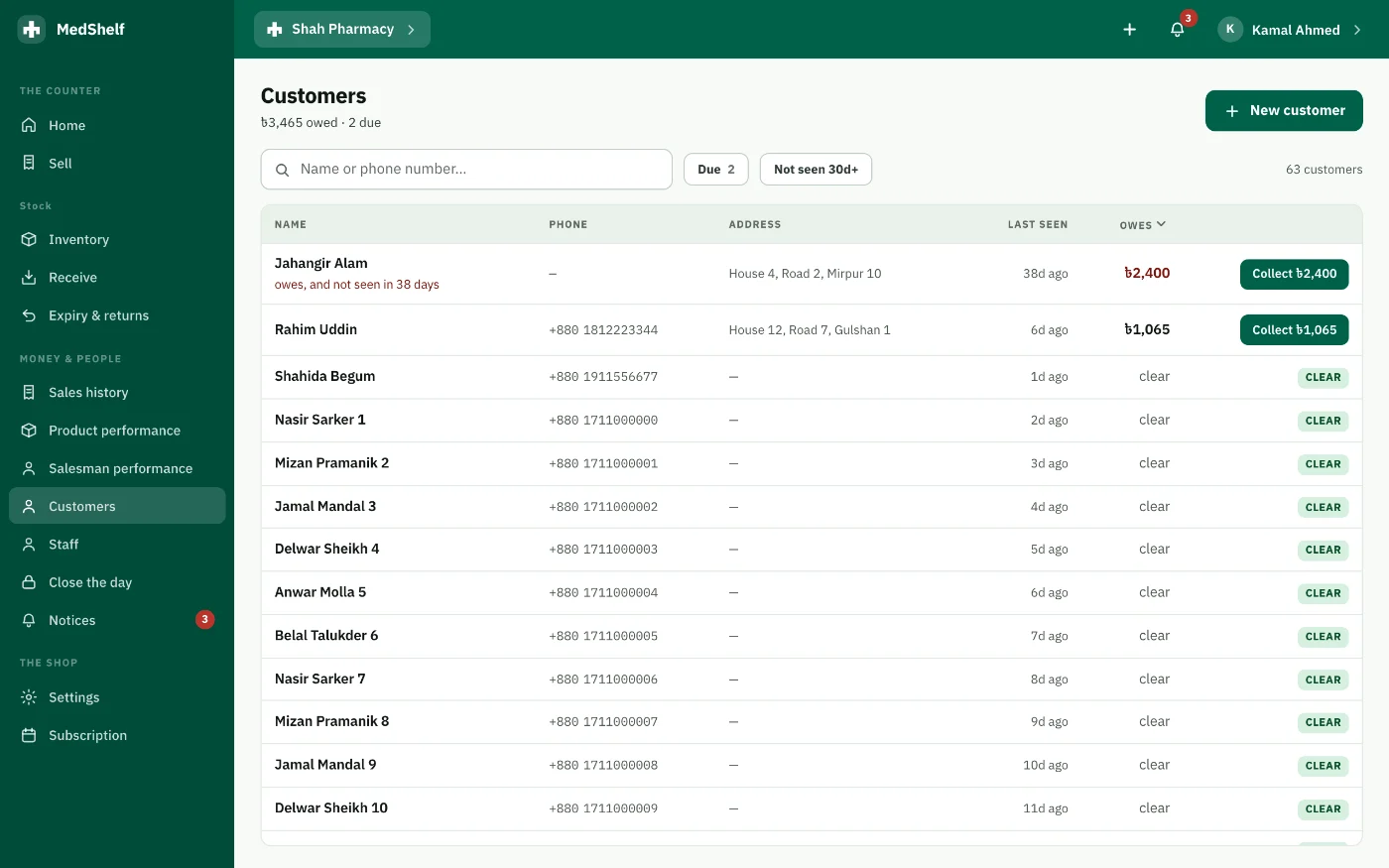
Who owes what, who has stopped coming in, and one control that takes money against the right invoice. Sort by the biggest debt or the smallest, and narrow to the people who owe and have not visited.
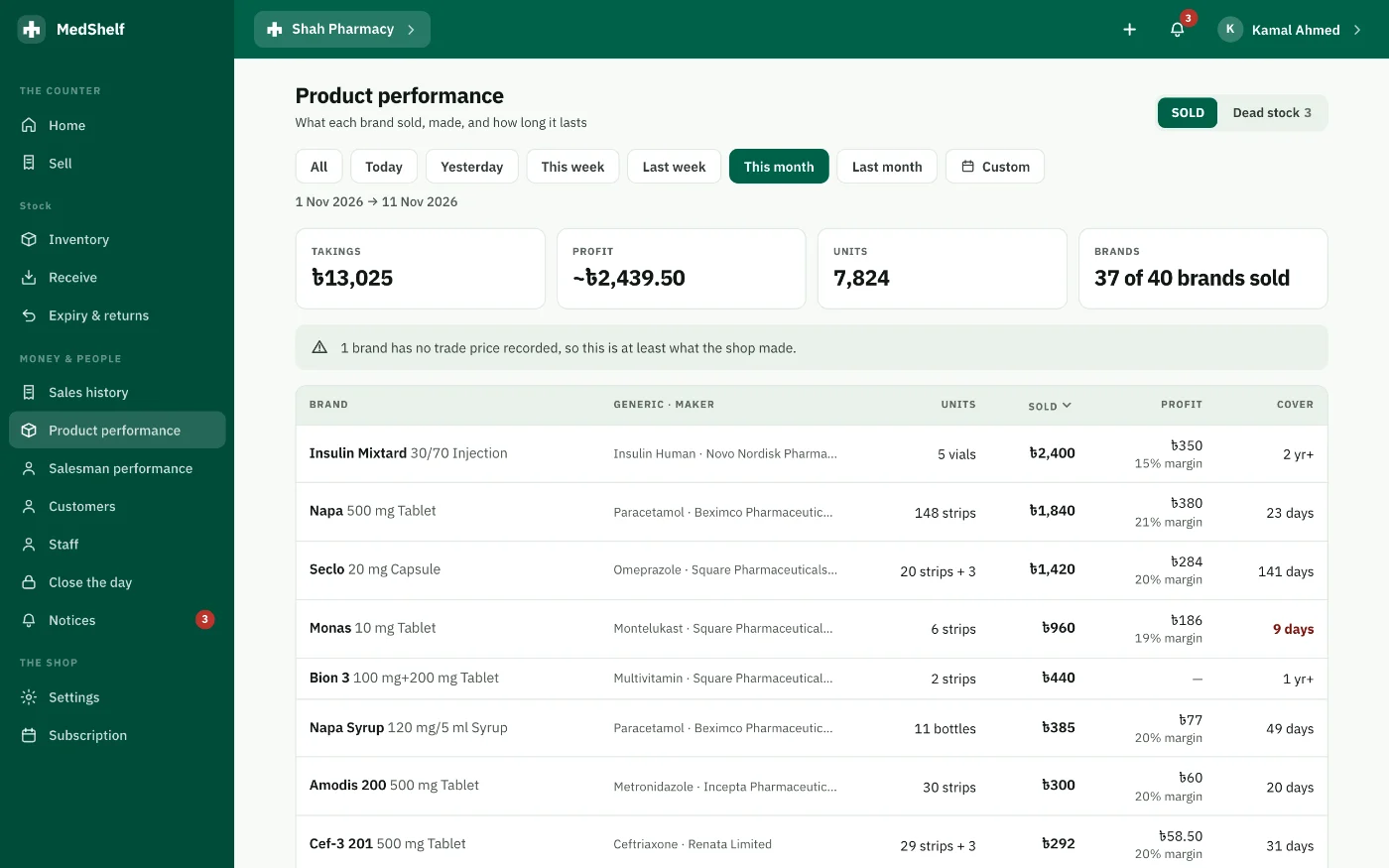
Which brands made the money and which made none, how many days of cover is left on each, and what is tied up in stock that has not moved. The trade price is captured at the moment of sale, so a delivery landing tomorrow cannot rewrite what today made.
Sample pharmacy data.
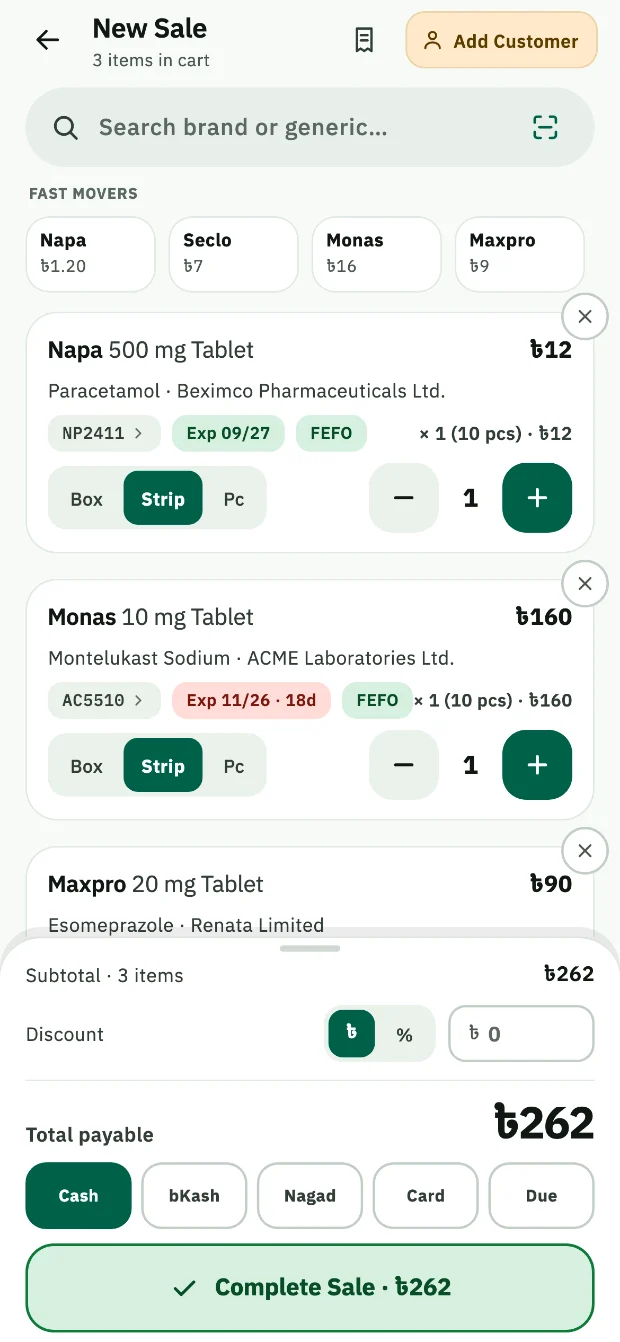
Two hundred sales a day with customers waiting at the counter. The checkout process is kept ultra-fast and streamlined — no unnecessary steps or extra clicks.
Type three letters to search across brand, generic name, manufacturer, and batch number — querying your entire pharmacy stock instantly.
Strip, bottle, tube, sachet, or single tablet. Select the packaging unit in hand, and the system automatically calculates exact piece counts.
Enter quantity. Earliest-expiry stock sells first (FEFO), and opened strips finish before cutting a new one.
Cash, bKash, Nagad, card, or customer credit — credit sales require customer details so you always know who owes what.
Hold for half a second to prevent accidental sales. The confirm button sits comfortably under your thumb for rapid checkout.
Track near-expiry products, distributor return deadlines, and total daily sales — right from your phone at the counter, in the time it takes to serve a single customer.
It is in বাংলা, the language the shop in it reads.
Written from the way a pharmacy in Bangladesh actually trades — strips and pieces, gazette price revisions, distributor returns, credit — rather than from a general retail template.
Cash, bKash, Nagad, card or credit, with the amount printed on the button that takes it. Change is counted out before the money moves.
Three letters match brand, generic, manufacturer or batch number — and the brands you already carry come first, because those are the ones you can sell.
The camera reads printed text: a brand name into the search box, a batch number and an expiry into a new carton. Typed once, not three times.
A batch is a real carton — its own batch number, expiry, trade price and printed MRP, counted in pieces. Receive a delivery and MedShelf says if that lot is already on the shelf.
150, 90, 30 and 7 days before the deadline, then on the day. Each warning names the carton and the money still in it.
A debt book you can sort by what is owed and filter down to the people who owe money and have stopped coming in. Collect in instalments against the oldest invoice.
A day, a week, a month or a range you pick. Which brands made the money, which brand has sold nothing, how many days of cover is left, and which salesman sold it.
A PDF in Bangla or English carrying every batch number, to print on any connected printer or send to the customer on WhatsApp. 58mm thermal roll support is in progress.
Six switches per person, enforced on the server. At night the drawer is counted note by note against what the day should hold, and only then is the day filed.
One login, one shop, one set of books. Which one you reach for is a question about where you are standing, not about which half of the product you bought.
The screen a sale is made on. Four tabs, a basket that survives a detour, a thumb-sized confirm, and the camera for anything printed on a box. Android, from Google Play.
The shelf, on the Android app
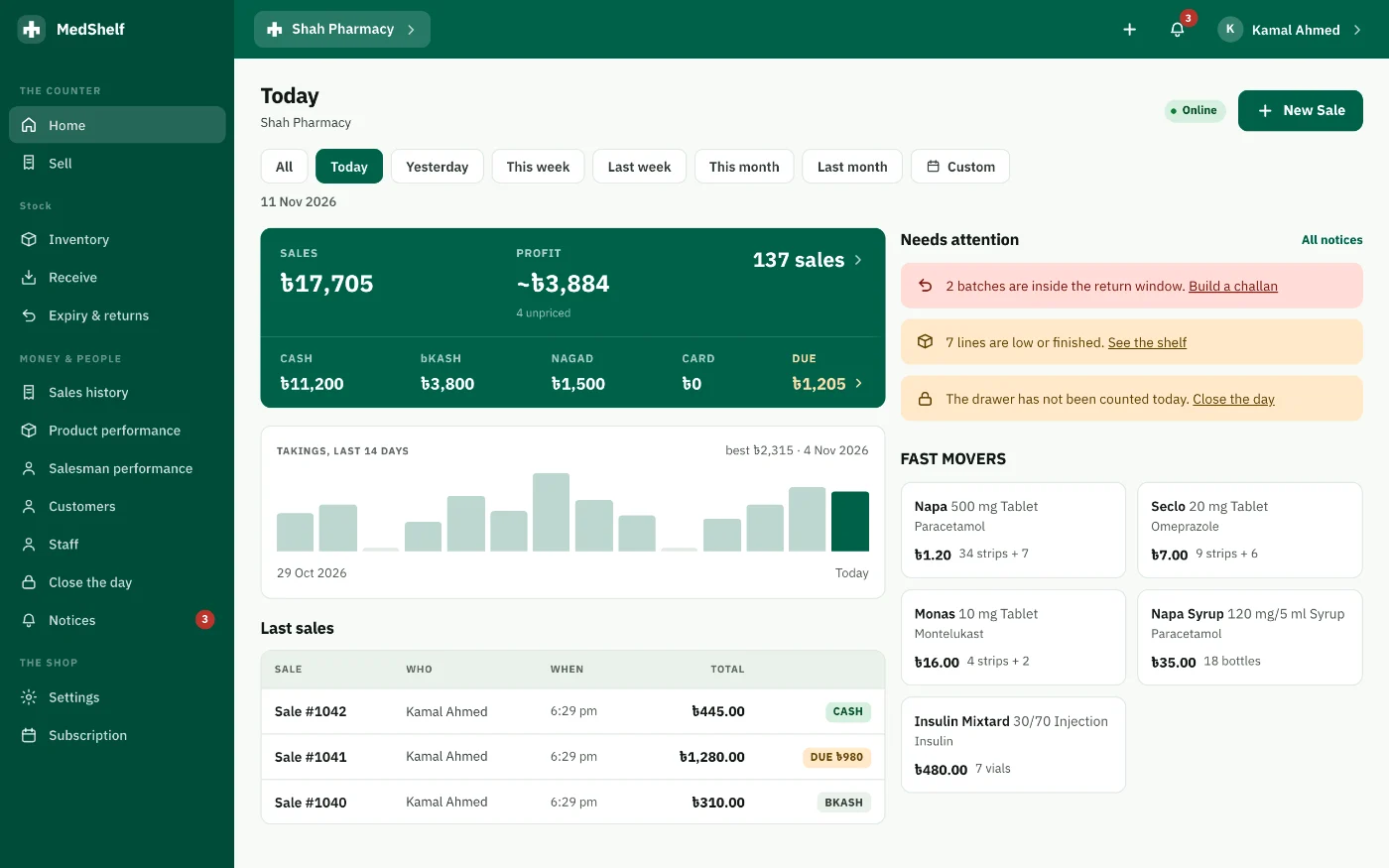
Two columns, so the cart and the total never leave the screen at once. Keyboard shortcuts along the bottom edge, tables instead of cards, and a sidebar with every destination one click away.
Home, in a browser
A pharmacy with eight hundred lines on the shelf will never shut the shutter to type them in. So MedShelf does not ask you to.
Your name, an email and a password. A six-digit code to the inbox proves the address, which is also how you get back in if you forget the password.
Shop name, phone, district, and which classification you trade under — Model Pharmacy, Model Medicine Shop or general retail — with the drug licence number. You can add the licence later.
No stock entry up front. The first time each brand is sold, MedShelf asks how many are on the shelf — so a fortnight of ordinary trading counts the whole shop, and you can skip any brand and come back to it.
One login opens as many pharmacies as you own, each with its own ledger, drawer, staff and stock.
When multiple staff sell at once, offline apps cause stock mismatches. MedShelf settles every transaction on the server as it happens, so inventory and accounts always match across every device.
Switch languages directly from the login screen, not buried in settings — so staff comfortable with Bangla can choose it right away. Receipts and PDF invoices follow the same preference.
Expiry dates, MRP, and trade prices stay in standard digits in both languages to match printed product packaging directly without confusion — and the carton prints 09/27.
The thirteen things a shop wants settled before it puts software between a pharmacist and their own ledger.
MedShelf is pharmacy management software for Bangladesh. It is a point of sale for the counter, a stock book that knows what is on the shelf by carton, a credit book for what customers owe, and a day-close that balances the cash drawer — in one place, on the Android phone at your counter and in any web browser.
Retail pharmacies — Model Pharmacies, Model Medicine Shops and general medicine retailers. It works the same for an owner serving alone as for a shop with five salesmen, because the permissions are per person rather than per role.
Any Android smartphone you already own, or a computer with a web browser. No special barcode scanners or machines required, and no technician visits needed. Sign up, enter your pharmacy name, and start selling this afternoon.
Yes. Every pharmacy starts with a free trial. The length is fixed when the pharmacy is created and is never shortened by a later change to the offer, so the days you were given are the days you keep.
Carrying on needs a current subscription, and the figure that applies to your pharmacy is quoted on your own subscription screen once you have signed in — that is the one place a price is stated, so what you read there is what you pay. Your records are never deleted, and reading them, collecting dues, cancelling a sale and closing the day all keep working.
Yes, and that is a deliberate trade. One pharmacy has one set of books and they live on the server, so when two counters sell the last strip at the same moment there is exactly one answer instead of two that disagree at stock take. The cost is real: with no signal the app will not ring up a sale.
Stock is held by carton, not by brand. Each batch carries its own batch number, expiry, trade price and printed MRP, and is counted in pieces — so a strip of ten and a loose tablet are the same arithmetic. Selling takes from the earliest-expiring carton first and finishes an opened strip before cutting a new one, and you can override that to the carton actually in your hand.
Yes, and the return deadline is the one that matters. A distributor stops accepting stock back three to six months before expiry, so the loss lands on product that is still perfectly saleable. MedShelf warns at 150, 90, 30 and 7 days, names the carton and says how much is still recoverable.
Yes. A credit sale will not go through without a customer on it, so there is always a name against the money. The book can be sorted by what is owed and narrowed to the people who owe and have stopped coming in, and a payment of any amount clears the oldest invoices first.
Yes. One login lets you manage any number of pharmacies, and each keeps an independent ledger, cash drawer, staff list and stock. You can own one shop and be a salesman at another with a different set of permissions.
Yes. MedShelf builds a PDF invoice and hands it to the phone's own print and share sheet, so it prints on any connected printer and can be sent to the customer on WhatsApp. Invoices come out in Bangla or English with every batch number listed. Direct 58mm thermal roll support is still in progress.
Only if you grant permission. Seeing the trade price is one of the six per-person switches; with it off, the cost is not sent to that phone at all — so the screen shows no cost column rather than a dash or a misleading zero.
Yes, and that is where it started. The same shop, the same books and the same login on both — the browser adds two columns and keyboard shortcuts, and the phone is built to be worked with one thumb at a counter.
Enter your name, email, verification code, and drug licence info. Start selling immediately while shelf inventory reconciles organically over the next two weeks.